Behind the work
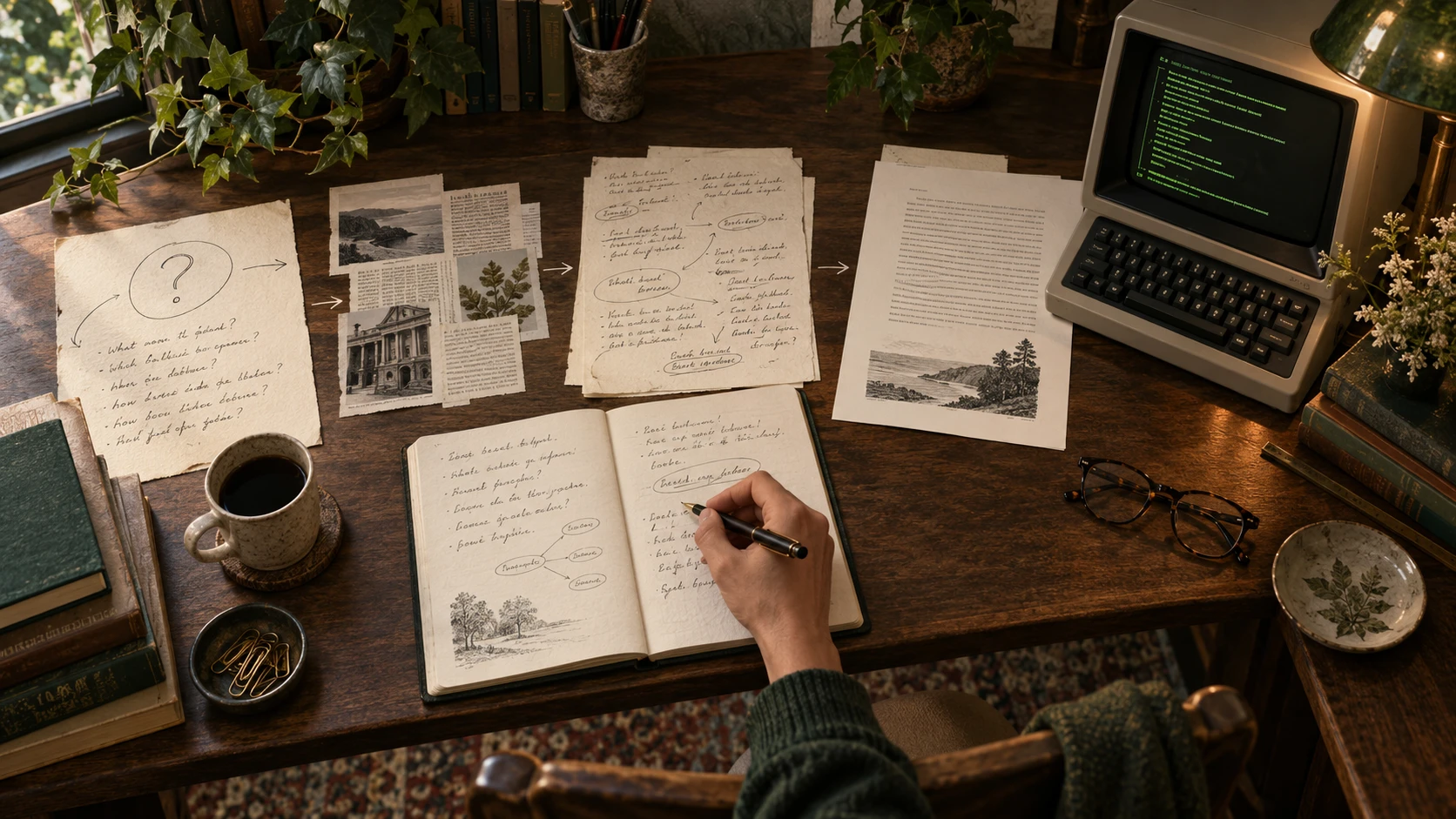
When someone reads an article, they usually see the finished result. They don’t see the question that started it, the sources that complicated the argument, or the conversation that made the writer change their mind. They don’t see the paragraph that was abandoned because the evidence didn’t support it.
That has always been true. But AI makes the distance between the finished text and the work behind it more difficult to interpret.
An article can be beautifully written by AI and contain a substantial amount of human thought. It can also be written entirely by a person and contain very little original investigation. Looking at the language alone tells us surprisingly little about how the argument developed.
This is the problem I want to explore with Behind the Work, a small project I’ve started building: a place where writers can keep the material that shaped their work and choose what to share with readers.
What I want to make visible
For this project, my main concern is the human contribution to the thinking.
Who framed the question? Who developed the thesis? Who chose the sources and decided which ones deserved closer attention? Who noticed that an explanation was too convenient, or that two apparently contradictory findings might both be true?
AI can help with all of these activities. Using it doesn’t automatically remove the human contribution. But the contribution becomes easier to understand when we can see what the person actually did.
There is a difference between asking an AI to write an article about the dollar as a safe currency and bringing it a question you have already begun to investigate:
This is the thesis I want to explore. These are the sources I’ve found. This part of the argument worries me. Look for evidence against it, find additional sources, and help me explain where the claim holds and where it breaks down.
The second instruction gives us a clearer starting point. Even then, the most interesting evidence may come later, when the writer evaluates the response, rejects a suggestion, corrects a mistake or changes the thesis.
I want a place to keep that development.
An example: following an argument
Imagine that I’m researching why the dollar sometimes strengthens during periods of uncertainty.
I might begin with a straightforward hypothesis: investors see it as a safe place to hold their money. Then I collect a few sources and ask AI to help me investigate other explanations.
The conversation might bring up demand for liquidity, interest-rate expectations or the need to repay dollar-denominated debt. Some of those possibilities might be relevant to the period I’m studying; others might be distractions.
The useful record would include my original question, the sources we considered, and the exchanges that changed my understanding. It might also include a note explaining why I dropped one explanation or narrowed the article’s scope.
By the time the article is finished, AI might have helped organise the argument and draft much of the wording. A reader could still see the work I did to direct the investigation and decide what I was prepared to say.
That is much closer to what I mean by documenting a human contribution.
The same idea applies to fiction
With fiction, the material would look different, but the underlying question is similar.
A writer might develop a character’s motivation, a difficult relationship or a rule governing an imagined world. They might use AI to explore possible scenes, test dialogue or suggest ways to connect events.
The important decisions could be quite small. A character refuses an apparently sensible offer because accepting it would contradict something established earlier. A scene is removed because it explains too much. A proposed ending is rejected because it resolves the plot while leaving the emotional problem untouched.
Those choices shape the story. They are worth keeping, even if an AI later helps turn them into prose.
Of course, a fiction writer may want most of this material to remain private. Research notes can contain spoilers, discarded endings and ideas intended for another book. The ability to select what becomes public is therefore central to the project.
Keeping conversations readable
One small feature I wanted was a clear visual distinction between my words and an AI’s response.
You can select an AI passage and mark it so that it appears as green text on a black background, with a monospace font. It has the feel of an old computer terminal.
There is a practical reason for this. A long pasted conversation can become difficult to follow when every paragraph looks the same. Separating the AI passages makes it easier to see the question, the response and the writer’s next intervention.
The marking is supplied by the author. It is a way of presenting the conversation clearly, rather than a system that detects who wrote each sentence.
I also like the visual reminder: this passage came from an interaction with a computer, and it should be read with that context in mind.
From a private project to a public link
A project starts as a private workspace.
You can add entries, update them and return to earlier revisions. Entries and projects can be moved to Trash and restored. Keeping a record shouldn’t require getting everything right on the first attempt.
When you want to share some of the work, you choose the entries readers can see and preview the resulting page before publishing it.
The project can include a link to the Substack article. In return, the article can link to the public project page, giving interested readers somewhere to explore the sources, notes and conversations behind it.
Readers don’t need an account to open that public page.
Publication is a deliberate step. Adding a new private note or changing an existing entry doesn’t immediately change what readers see. You publish again when you are ready to share an updated version.
What a record can establish
There are limits to what this can tell a reader, and I want those limits to remain clear.
A saved note can show what was recorded in the application and when. A conversation can show the instructions and responses an author chose to preserve. A sequence of revisions can help explain how an argument developed.
None of this proves that an idea first originated in a particular person’s mind.
Someone could bring material from elsewhere and describe it as their own. They could publish a carefully selected history that leaves out inconvenient parts of the process. A detailed record can still be misleading.
The application therefore distinguishes the date someone supplies for their material from the time the system records it. And the public page is a selection made by the author, rather than a promise that every step is present.
The value lies in giving readers more evidence to consider. The record still needs to be read critically.
Who I hope will find it useful
I’m starting with writers and researchers who already have material scattered across documents, browser tabs, notes and AI conversations.
Some may want a public companion to an article. Others may mainly want to remember why they reached a conclusion six months ago.
That second use matters to me. Even if nobody opens a public project page, the private record should help its author. It should make it easier to return to a source, recover a useful exchange or understand why an earlier draft took a different direction.
For readers, the benefit is optional depth. Most people will simply read the article. Someone who wants to investigate a claim or understand how the author used AI can follow the link.
The article should remain readable on its own.
What comes next
Behind the Work is at an early stage. The current version is deliberately small, and I want to learn from using it before adding more structure. You can log in easily from the homepage - you don’t need an email or to verify your identity - just choose and handle and we will produce a passkey unique for you. - make sure you store the recovery code in case something goes wrong and that’s it - you’re set.
The only requirement is to subscribe to “The AI Developer” where we will email you a confirmation code - which you will need to use to confirm the subscription and confirm your use of the application.
I want to find out what is actually worth saving, how much context readers need and whether people find the public records useful. I also want to understand where keeping evidence helps a writer and where it becomes an interruption.
More elaborate features can wait until there is a clear need for them.
For now, the aim is straightforward: keep the material that helps explain how a piece of work came into being, and make it possible to share that material openly.
AI is becoming part of how many of us research, write and develop ideas. I want a better way to show the judgment we exercise within that process.
Behind the Work is my first attempt to make that thinking visible, to see how it works you can find all the work that went behind producing this post here
Originally published on Substack on 03 October 2026.