Thirteen Seconds to Leave the Ship
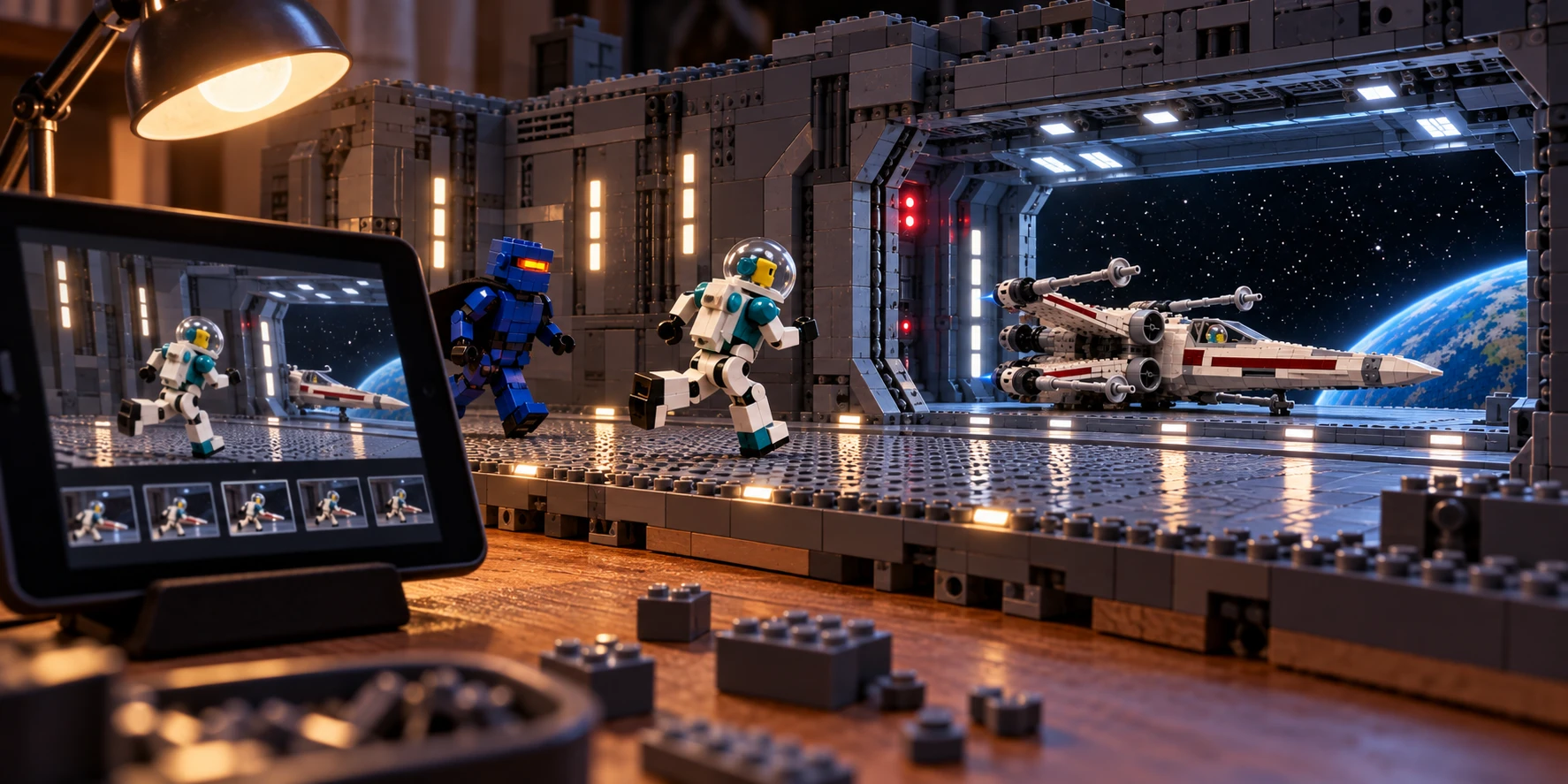
The first difficulty was getting the hero to lift a foot. We had a corridor aboard a spacecraft, a blue robot, a white-and-teal explorer and two luminous swords. There was enough material here for a confrontation, and probably enough for several sequels, but the movement needed attention. A figure could change position between pictures without appearing to walk. Its legs had to explain how it had arrived there. One of the early images was replaced because the pose was too stiff; the raised boot in its replacement did a modest but necessary piece of work. Before we could arrange an escape from a doomed ship, we had to persuade a small artificial person to take a step.
This is the sort of problem I wanted to make room for when building Movie Studio, an app for children and families to make short films from still images. The idea is straightforward: begin with a story, arrange what happens into scenes, take or import pictures, and play them in sequence. An iPad can serve as the camera and the place where the film is assembled. A toy on a table can become a character; a few objects placed behind it can establish where it lives. Once the first pictures are moving, the questions become specific. Has the character crossed the room too quickly? Can we understand what it is reaching for? Should something happen before it goes through the door? Those are questions a child can investigate by changing a few pictures and watching again.
Our first experiment grew into Brick Space Escape, an eighty-frame silent adventure. It begins with the confrontation in the corridor. The explorer defeats the blue robot, runs through the ship, reaches a hangar, climbs into a small fighter and escapes as the larger vessel explodes. The plot gives its protagonist very little leisure, which is reasonable under the circumstances. At the saved speed of six frames per second, the whole sequence takes approximately thirteen seconds. There is no dialogue to explain an intention or repair a confusing action. The pictures have to show enough of the journey for the next event to make sense.
Watch Brick Space Escape — our first Movie Studio
The images in this particular film were generated with AI, then imported into Movie Studio in order. They were not photographs of physical models, and the app did not produce the whole adventure from a single instruction. We began with twenty frames covering the approach and duel, then added sixty more to carry the explorer out of the corridor and into space. That extension required decisions which the original fight had conveniently postponed. Where was the exit? How did the explorer reach the fighter? When should the view move outside the ship? A dramatic picture of an explosion could supply an ending, but the preceding pictures still had to get the hero somewhere from which an escape was possible.
The process also exposed the limitations of the material. Fine details of the figures and the background can change between generated images. A convincing individual picture does not guarantee a convincing sequence, because the viewer remembers what was present a moment earlier. The legs needed different positions, while the character needed to remain recognisably the same character. The setting had to change when we moved into another part of the ship, while retaining enough continuity for the movement to be understood. Our short film is visibly an early experiment. Its imperfections are useful because they make the next pieces of work quite easy to identify: more consistent poses, clearer movement and better control over what changes from one frame to the next.
Movie Studio also supports the more familiar way of making stop-motion: put an object in front of the camera, take a picture, move it a little, and take another. In Director Mode, the previous image can be shown faintly over the camera view, so the filmmaker can compare positions before capturing the next frame. This is usually called onion skinning, although no vegetables are involved. There are controls to help line up the background and steady the capture, and pictures can be retaken or deleted. Existing photographs can be added from Photos. The purpose of these tools is practical: make it easier to notice an unintended change while the scene is still in front of you and can still be repaired.
Some of the work behind the app has been equally practical. Importing a large collection of pictures could put too much pressure on the iPad’s memory. A film that works with a handful of frames and struggles as soon as its maker becomes ambitious has a rather unfortunate design limit. The import process now handles pictures one at a time, prepares them at a consistent size and shows its progress. The editing view keeps the most recent thumbnails visible without asking the device to display every full-sized picture at once. These are small engineering decisions, but they affect whether someone can continue a story after the first scene. The eighty-frame escape gave us a concrete sequence to assemble and check from beginning to end.
Finishing and showing a film are part of the app too. A project can be marked finished with its playback speed saved, then watched from the finished-movies library. Movies remain private unless their owner enables a sharing link, such as the one above. A visitor can watch that particular film without entering the studio or receiving editing controls, and the owner can revoke the link. At present the finished film plays its sequence of images in the browser. Downloadable video files and sound remain work for later versions; this first adventure is silent, and the link opens its own player.
What interests me about this small studio is how quickly an imagined event becomes a series of decisions that can be examined. In a story, it takes very little space to write that someone runs to a spacecraft and escapes. To show it, we have to supply a route, a succession of movements and enough time for the viewer to follow them. A missing step becomes visible. So does an unnecessary one. That is a satisfying kind of making, whether the material begins as photographs of toys or generated pictures of an invented world. We now have eighty frames in which a little explorer survives a duel and leaves an exploding ship. For the next film, we can begin with what those thirteen seconds have taught us.
Originally published on Substack on 15 September 2026.