Cheap Yen, Expensive Risk: Why the Carry Trade Makes Markets Nervous

21 September 2026 — market developments checked through 18 September. Numerical scenarios are illustrative, not live investment quotes.
Borrowing cheaply in Japan and investing the money somewhere that pays more sounds like a sensible response to an uneven world. If yen funding costs less than the income available on dollar, euro or sterling assets, why leave the difference uncollected? This is the attraction of the yen carry trade. It is also why bond-market turbulence raises an uncomfortable question: what happens when large numbers of investors try to reverse it together?
The risk is real. But neither an inevitable financial crisis nor an invitation to double down follows automatically from rising Japanese yields. The outcome depends on exchange rates, borrowing terms, the investments purchased and how much leverage investors have used.
Japan’s September bond auction illustrates how far conditions have moved: its ten-year government bond sold at an average-price yield of 2.995%, with the lowest accepted price corresponding to 3.011%. On 18 September, the Bank of Japan raised its short-term policy rate to around 1.25%. Those are different rates: the ten-year yield describes a long-term investment, while short-term rates are more directly relevant to many carry traders’ funding costs. Japan’s Ministry of Finance, Bank of Japan decision.
Japan still has lower policy rates than the other currencies under discussion:
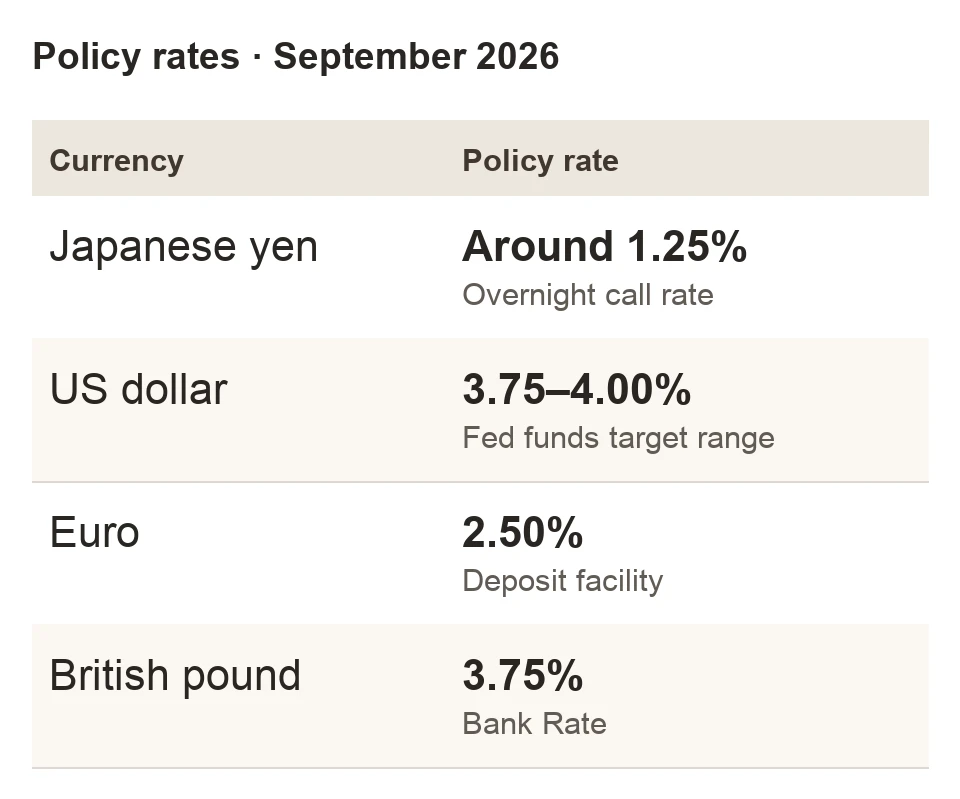
Following the September 2026 decisions. Policy rates, not personal borrowing or investment quotes. Sources: Bank of Japan, 18 September; Federal Reserve, 16 September; ECB, 10 September, effective 16 September; Bank of England, 17 September.
These figures provide context; they are not rates at which an individual can necessarily borrow or invest. They also show why the argument needs care. The Federal Reserve and ECB raised rates too. Japan’s increase has not, by itself, eliminated the interest-rate advantage abroad.
The more immediate danger is the interaction between falling asset prices and a rising funding currency. When bond yields rise, existing fixed-rate bonds generally lose value. An investor who borrowed yen to buy a long-dated foreign bond can suffer that loss while also paying more to finance the position. If the yen strengthens, converting the investment back into yen produces less money with which to repay the loan. A higher yield available to a new buyer does nothing to reimburse the previous owner’s capital loss.
For illustration, a bond with a modified duration of eight would lose approximately 8% in price if its yield rose by one percentage point, before allowing for income and the curvature of the price-yield relationship. That can overwhelm a modest annual interest advantage. Holding to maturity may avoid realising an interim bond-price loss, provided the issuer pays, but it does not remove currency risk or prevent a lender from demanding more collateral along the way.
Higher Japanese yields can also encourage Japanese investors to keep more money at home, or bring some back from overseas. That could weaken demand for foreign bonds. However, a Japanese insurer reallocating its own portfolio is different from a hedge fund closing a leveraged yen position. Treating every Japanese overseas investment as a carry trade exaggerates both the size of the trade and the certainty of an abrupt exit.
The frightening part is the possibility of forced selling. An investor facing losses sells foreign assets and buys yen to repay borrowing. Those transactions can push the assets down and the yen up, worsening the position of other investors doing the same thing. Lenders may then require more collateral, prompting further sales. Investors can also sell unrelated holdings to raise cash, spreading the disturbance beyond the original trade. The BIS identified deleveraging and margin increases as amplifiers of the August 2024 turbulence. BIS analysis of the 2024 unwind.
That episode shows both the seriousness of the mechanism and the limits of catastrophe predictions. Japan’s TOPIX index lost about 12% on 5 August 2024, but markets subsequently stabilised quickly. The BIS estimated yen carry positions before that event at roughly ¥40 trillion, or $250 billion, while stressing substantial measurement gaps. That was an estimate for 2024, not a reliable live total for today. BIS Bulletin 90.
September’s currency movements offer another useful warning against simple forecasts. Reuters reported on 8 September that the yen had strengthened to 152.89 per dollar after trading around 160 less than a week earlier. Yet the yen weakened after the Bank of Japan’s 18 September increase, as traders reassessed the prospects for subsequent hikes. Markets respond to the difference between expectations and outcomes, not merely to whether a central bank raises rates. Reuters, 8 September, Reuters, 18 September.
My assessment is therefore that a disorderly unwind is a serious market risk, particularly for leveraged investors. A systemic financial crisis would require further evidence of funding problems, counterparty losses or impaired market functioning. Rising bond yields alone do not establish that case. Nor do higher Japanese yields guarantee a stronger yen: yields rising because investors demand compensation for inflation or fiscal uncertainty can coexist with currency weakness.
For someone considering the trade personally, the arithmetic matters more than the headline. Imagine borrowing ¥15 million for one year at an all-in interest rate of 2.5%, converting it at ¥150 per dollar, and investing the resulting $100,000 at 4%. Assume both interest rates remain fixed, the investment pays in full, and there are no taxes or transaction charges. After a year, the dollar investment is worth $104,000 and the yen debt is ¥15.375 million.
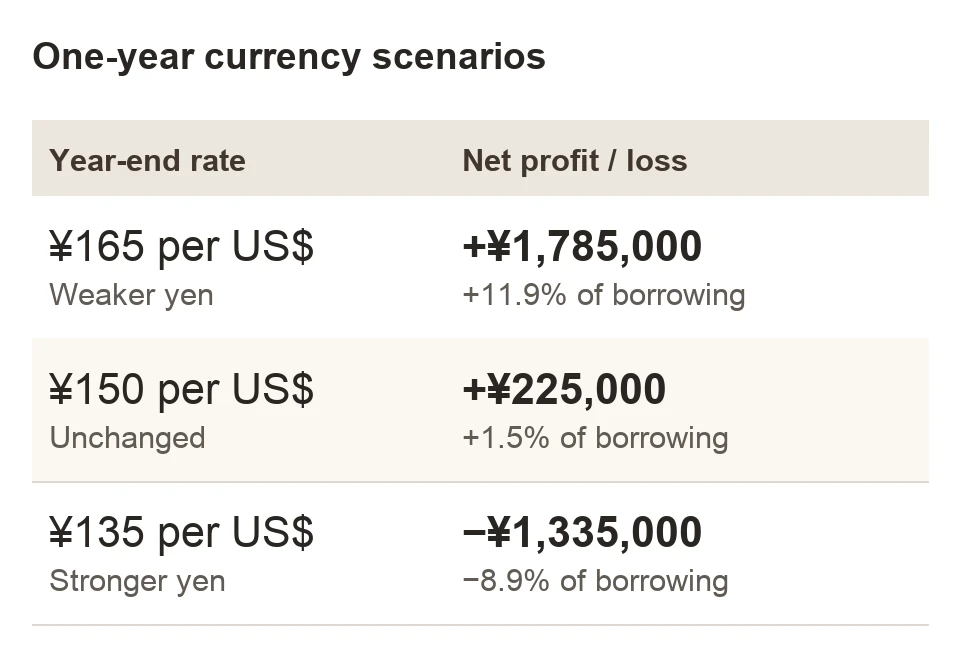
Percentage results use the original yen borrowing. Hypothetical one-year results; excludes taxes and fees.
These are returns measured in yen relative to the borrowed amount, not returns on the investor’s own capital. If borrowing equals five times the equity supporting the position, the final scenario consumes about 44.5% of that equity, assuming its yen value is otherwise unchanged. Forced liquidation could occur before the year ends. Even a move from ¥150 to approximately ¥147.84 per dollar erases the entire year’s interest advantage. The same calculation works for euros or pounds using their actual investment returns and exchange rates against the yen.
This is why I would not recommend “double down” as general advice. Increasing a position makes sense only if the expected compensation has improved enough to justify the risk and the investor can withstand further losses. A falling foreign bond price might improve its prospective return; a cheaper yen might make the existing trade profitable while leaving a new entrant exposed to a reversal. Neither observation proves that increasing borrowing is attractive.
There can be a rational case for a carefully sized carry position: a worthwhile net interest advantage, a defensible view that the yen will remain stable or weaken, manageable borrowing terms and ample spare collateral. The opposing case is equally concrete: further yen appreciation, a smaller interest gap, losses on the purchased assets, or tighter lending conditions. An attractive investment bought with existing cash can become an unattractive position once foreign-currency borrowing is added.
Borrowing yen to buy dollars, euros or pounds is technically possible through some eligible multicurrency margin accounts or secured bank facilities. The essential position is a yen liability alongside assets in another currency. Availability depends on the lender, legal entity, residence, account type and permissions; changing an account’s reporting currency does not create yen financing. Interactive Brokers, for example, documents currency borrowing for eligible margin accounts and prohibits it in cash accounts. IBKR account rules.
The practical comparison must use the lender’s actual yen borrowing charge and the return the chosen foreign asset actually pays, after fees and relevant taxes. Simply holding dollars does not guarantee a Treasury-like yield. Broker cash interest can depend on balance thresholds and account size, while loan pricing includes the lender’s spread. The euro’s smaller policy-rate gap makes checking those costs particularly important; buying all three currencies still leaves a common exposure to yen strength. IBKR financing and cash-interest terms.
Hedging the exchange rate changes the economics. For comparable credit risk and matching maturities, forward exchange rates normally offset most of the money-market interest differential. Deviations and other bond spreads can remain, but fully hedging the currency does not generally preserve an easy, risk-free profit from borrowing in the cheaper currency. Buying currency options instead has an explicit premium that reduces the carry. BIS explanation of covered interest parity.
The carry trade can remain profitable, and an unwind need not become a crisis. But a recommendation to increase exposure requires more than the observation that Japan still has lower interest rates. Before borrowing, calculate the loss from a substantial yen appreciation, add a plausible fall in the purchased assets, and check whether the position would survive the resulting collateral demands. A small annual income advantage is valuable only if the investor can afford the risks required to collect it.
Originally published on Substack on 21 September 2026.