From BusinessTycoon
to My Empire
Yesterday I wrote about BusinessTycoon and the idea of starting with $100 million, investing it, building companies, and trying to reach the first billion. Today I wanted to look more closely at what we have actually built, how the idea developed through prompts, and whether the result flows as a game.
So I asked Codex to play it. The industry walkthroughs below continued existing campaigns in the live browser demos. The shared-wallet and ownership tests used a disposable local My Empire career. These are observations from one playthrough, rather than a claim that the whole economy has been balanced.
The first request was to give the games something in common:
lets first work on how you make a common engine - it could be fictional - but it needs - news - and financial markets
Then came a much shorter instruction:
make it fun
That is probably the hardest requirement to test. You can check that money moves correctly between accounts. You still have to play to discover whether a decision feels interesting, whether its consequences make sense, and whether there is a reason to come back.
The bigger change came when I realised that the tycoon should have a continuing life across several businesses:
the tycoon can have several companies and investments
That became the request to build the layer now called My Empire:
yes lets build My Empire - connect the WallStreetGame balance to all companies and investments, with partial ownership, then upload and deploy
This is quite a good example of how I use vibe coding. The specification develops through conversation. I start with an intention, look at what has appeared, and become more precise about what the product should do. The useful work includes asking awkward questions about the result: whose money is this, what does ownership mean, and what happens when something fails?
My Empire gives the game one financial centre. WallStreetGame supplies the existing virtual-money account, starting with its original $100 million grant. From there, the player can keep money in public-market investments or subscribe capital to companies and funds. Existing players carry their current balance into this relationship. Each new business has to be funded from available capital.
The ownership test makes this easier to understand. A 25% stake in a new $25 million streaming business costs the player $6.25 million. Fictional co-investors supply the other $18.75 million. If that company distributes $1 million, the player's wallet receives $250,000. The stake loses the corresponding value, so the distribution itself does not make the player richer. A subsequent $1 million equity subscription increased the test player's ownership to 28%, diluting the outside investors.
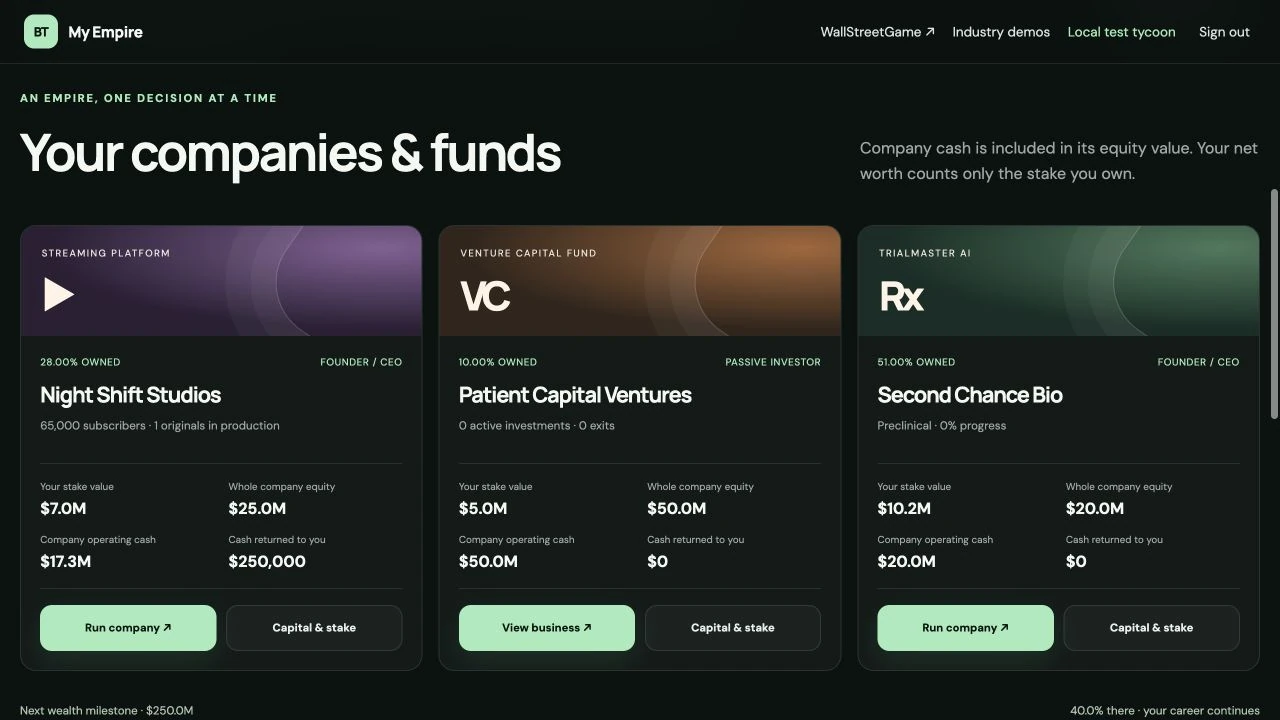
A local test career: the streaming stake is 28% after additional funding, the VC fund is a passive 10% holding, and the biotech company is 51% owned.
I can choose how much to own and whether to operate the business or leave it to independent management. Company operating cash belongs to all its shareholders. Personal net worth counts my proportion of company equity, which already includes that cash. Keeping those distinctions consistent is a substantial part of the work behind this apparently simple game.
Underneath, there are three main layers. The wallet and ownership ledger record capital movements. A shared world supplies the business clock, fictional interest rates, sector indices, market scenarios, boardroom choices and milestones. Industry modules then apply their own rules: clinical development and financing for TrialMaster AI; diligence, investments and exits for the venture fund; commissions, subscription prices and audience retention for streaming.
The browser demos save their campaigns locally. In the connected career, PHP and the database handle accounts and transactions, while the shared JavaScript simulation runs on the server. The browser submits decisions. Checks for stale saves and repeated requests help prevent an ordinary double-click or retry from moving money twice.
There is also an important distinction in the world itself. Public-market positions use WallStreetGame's market data. Company treasury indices and private valuations use simplified game models. I asked about CNN, the New York Times, the Guardian, Reuters and open news sources; during this playthrough, the newsroom showed Global Voices and ScienceDaily connected. Real headlines provide context, while authored scenarios drive the simulated economy. Connecting those two more meaningfully remains work to do.
The streaming demo currently has the clearest decision loop. Continuing from week four, Codex commissioned Small Planet, Big Ideas, arranged a cast livestream, and increased the subscription price from $9.90 to $12.90. Four simulated weeks later, the documentary premiered with a 68/100 review. The platform had 219,468 subscribers and about $1.5 million in monthly operating cash flow. The higher price also brought higher modeled churn. There was something to choose, a period of anticipation, and a result to interpret.
The venture fund took longer to tell its story. Diligence on Quiet Signal produced an encouraging assessment, followed by a $3 million investment. Several advances then returned a fairly generic message about the team continuing to build. Eventually, Second Sun exited at 2.6 times the investment and Quiet Signal at 3.5 times. By week 36, the demo showed $18.5 million distributed to investors and a 1.20 times fund multiple, including remaining cash. Those are satisfying events, but the weeks between investment and exit need more visible customer progress, founder decisions and explanations of changing valuations.
TrialMaster AI exposed the most concrete problems. Its lead molecule failed in preclinical development at week 24. Failure is an intended possibility. The confusing part was what the surrounding systems said afterwards: the sandbox still displayed a $43.9 million valuation alongside $16.7 million in cash, marked the “Reach Phase I” milestone complete, and kept the medical adviser supportive about the biological case.
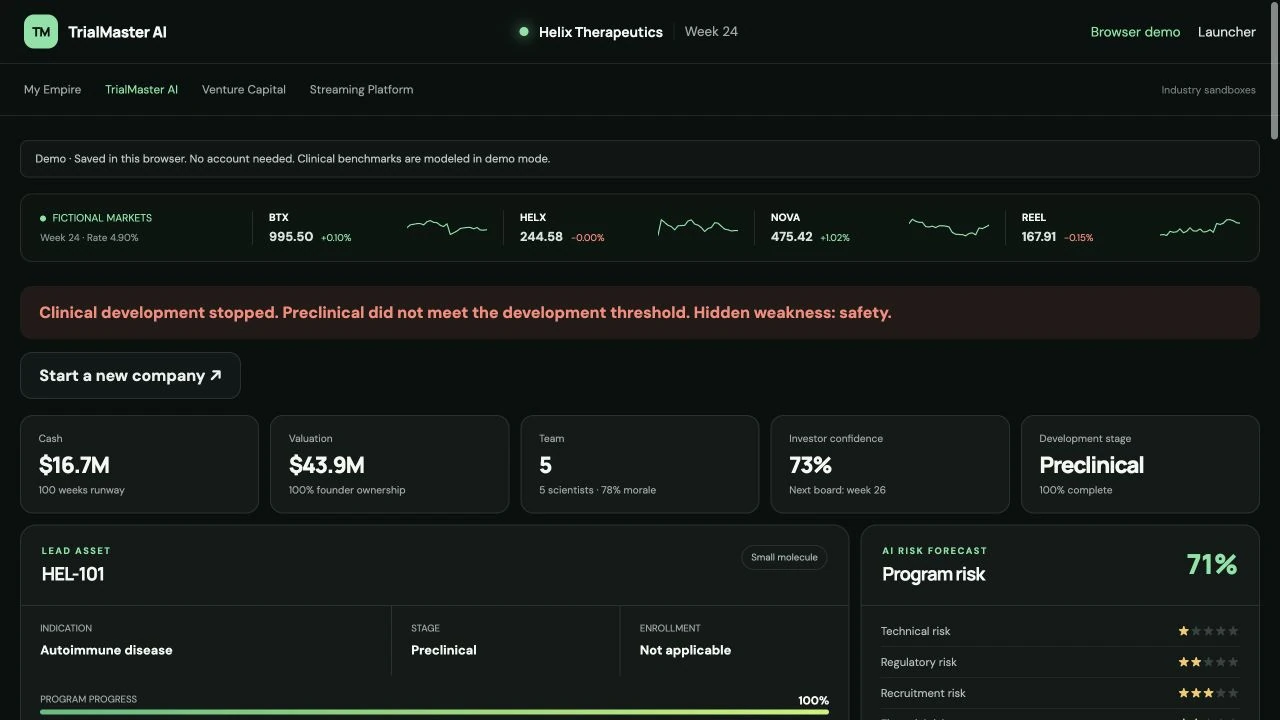
A useful playtest finding: the failure banner and the valuation tell different stories about the same company.
The connected career already has a separate valuation rule that removes the failed asset's intellectual-property value. The sandbox needs to agree with it. Milestones and adviser messages also need to follow the actual development outcome. These are specific fixes to make. The advisers are currently rule-based simulation guidance, and the demo's clinical benchmarks are modeled; the AI name should not obscure what the software is doing.
There are smaller clarity problems too. Changing a streaming subscription price updates the displayed price immediately while the revenue figure waits for the next simulation step. The interface should identify the last settled figures and show a separate projection. Money confirmations would also benefit from exact dollar amounts alongside abbreviated millions.
The next design task is the first session. Players encounter browser demos, separate cloud campaigns and My Empire, each with different persistence or timing. My Empire advances one business week per real hour, while the demos allow rapid advances. A guided introduction should explain the route, offer a meaningful first decision, and show what will happen while the player is away.
Then there is the economy to improve. Private stake sales currently use a fixed 10% liquidity discount after four business weeks, with modeled buyers. Company valuations use deliberately simple formulas. Longer playtests should examine whether different strategies remain interesting, whether losses have believable consequences, and how much of the journey towards a billion comes from spendable returns versus rising paper values.
This is the part of vibe coding that interests me most. A few conversational prompts can get a substantial, playable structure into existence. Automated checks can protect important money rules. Playing it reveals the gaps between the systems, and the moments where the design becomes engaging. Deciding which of those moments to develop still takes attention and judgement.
You can try the industry demos, or explore My Empire with a WallStreetGame account. The direction I want to keep developing is one continuing fortune, several businesses, and decisions whose consequences become a story worth following.