Four European jewels, and the price of owning them
I wanted to find a small group of European companies worth owning for the long term, each with something distinctive that would be difficult for a competitor to reproduce. Ferrari brings a brand built around desirability and scarcity. ASML brings the engineering behind advanced chipmaking. Alfa Laval brings specialised equipment that helps customers manage heat and use energy more efficiently. BioNTech brings the possibility of important new cancer treatments. The appeal of the four is easy to understand. The harder question is how much of that appeal is already reflected in their share prices.
My starting point was the close on 18 September 2026, using Ferrari and ASML in euros, Alfa Laval in Swedish kronor and BioNTech’s Nasdaq shares in dollars. I compared those prices with business results and explicit earnings estimates for 2026 and 2027. I also looked at the price histories, because a business beginning to grow faster and a share price beginning to recover are two different developments. Ideally, an investor would like evidence of both, at a valuation that leaves room for something to go wrong.
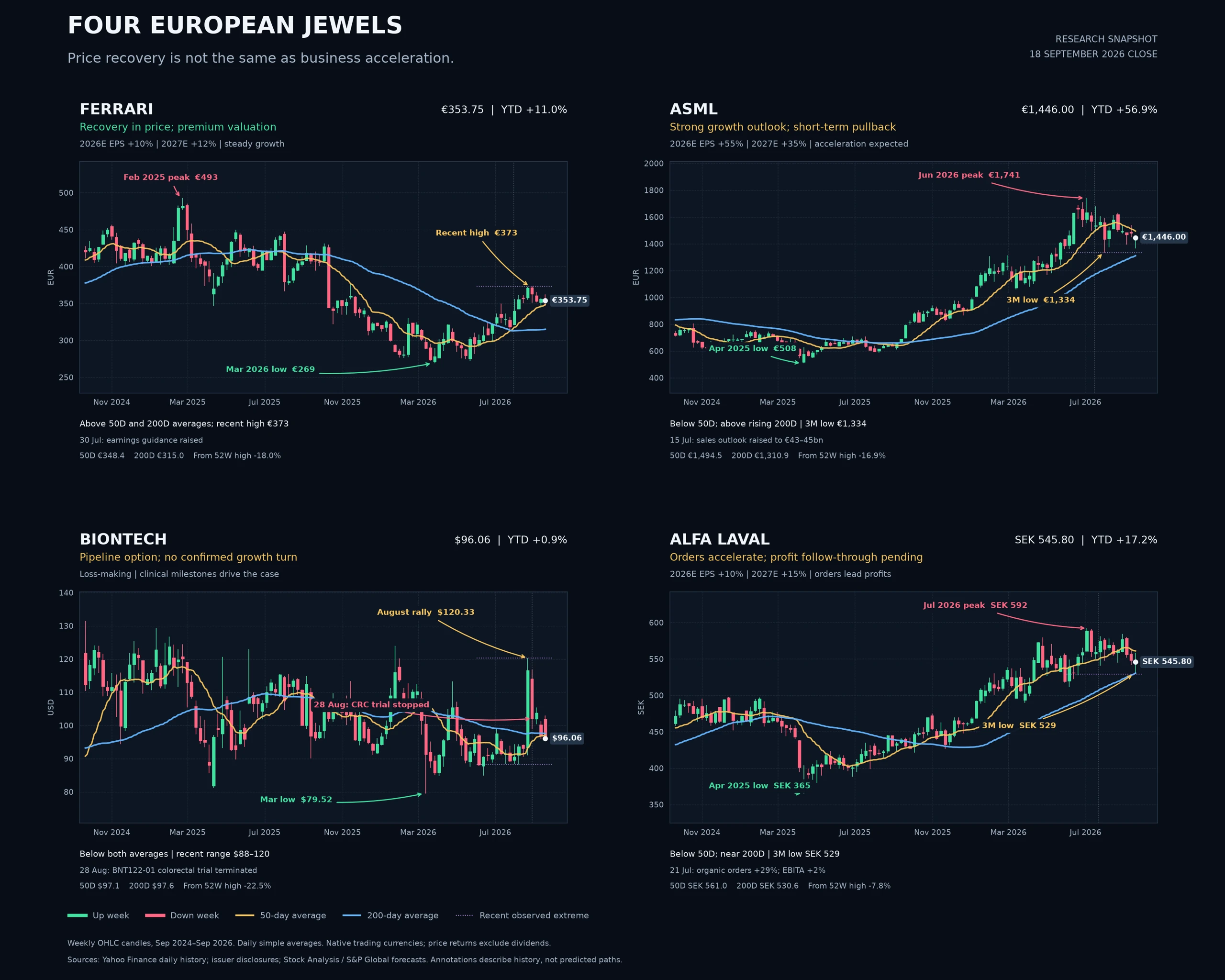
Prices through 18 September 2026. The arrows identify historical observations; they do not predict future price paths. Price returns exclude dividends.
Ferrari is the easiest business here to admire and one of the hardest to buy without hesitation. Its ability to earn more from personalisation and its product mix makes it unusual among carmakers. The latest results support that strength: second-quarter operating margin reached 31.2%, and the company raised its annual earnings guidance. Those are attractive business characteristics. They still have to be weighed against the purchase price. Ferrari’s results.
At €353.75, Ferrari trades at roughly 36 times estimated 2026 earnings and 32 times estimated 2027 earnings. The estimates imply earnings growth of about 10% and 12%, respectively. That is healthy growth, but it leaves me wanting more room between the price and my expectations. If next year’s earnings reach the €11.02 estimate and the market then values them at 30 times, the resulting share price would be about €331. That is a valuation illustration, not a forecast; it shows how a growing company can still disappoint its shareholders. Ferrari’s recovery above its longer-term moving average encourages me to keep watching, while the valuation makes me patient about buying. Earnings estimates.
ASML has the strongest case for a meaningful acceleration in the business. In July, management raised its annual sales outlook to €43–45 billion and projected third-quarter sales of €11–12 billion. The spending plans of chipmakers are feeding into demand for its equipment, although deliveries and revenue recognition still have to fulfil that outlook. ASML’s results.
The shares closed at €1,446, equivalent to around 38 times estimated 2026 earnings but 28 times estimated 2027 earnings. That difference reflects an ambitious expected rise in profits: approximately 55% earnings growth this year and another 35% next year. I can see a conditional case for buying gradually over a long horizon, because the expected growth gives the valuation more support. I would still want each subsequent result to strengthen the case. A slowdown in customer investment, shipment restrictions or disappointing margins could weaken both earnings expectations and the multiple investors will pay. Spreading purchases over time would not remove those risks. Earnings estimates.
Alfa Laval offers a different opportunity. Its heat-transfer equipment serves practical needs in cooling and energy efficiency, including data centres. The investment case is that customers will continue spending to improve the performance and economics of their operations. That is a useful connection to expanding computing infrastructure without depending entirely on the success of a particular AI model. Alfa Laval’s cooling technology.
There is encouraging evidence in the order book: organic orders grew 29% in the second quarter. However, adjusted operating earnings before amortisation grew only 2%, and the margin declined. Orders have accelerated; profits still need to follow. At SEK 545.80, the shares cost about 25 times estimated 2026 earnings and 22 times estimated 2027 earnings. That makes Alfa Laval the least demanding earnings valuation of these three profitable companies, although I would call it fair to full rather than cheap. It is a conditional buy candidate for me, with the next stage of the case resting on orders becoming profitable deliveries and cash. Quarterly results, earnings estimates.
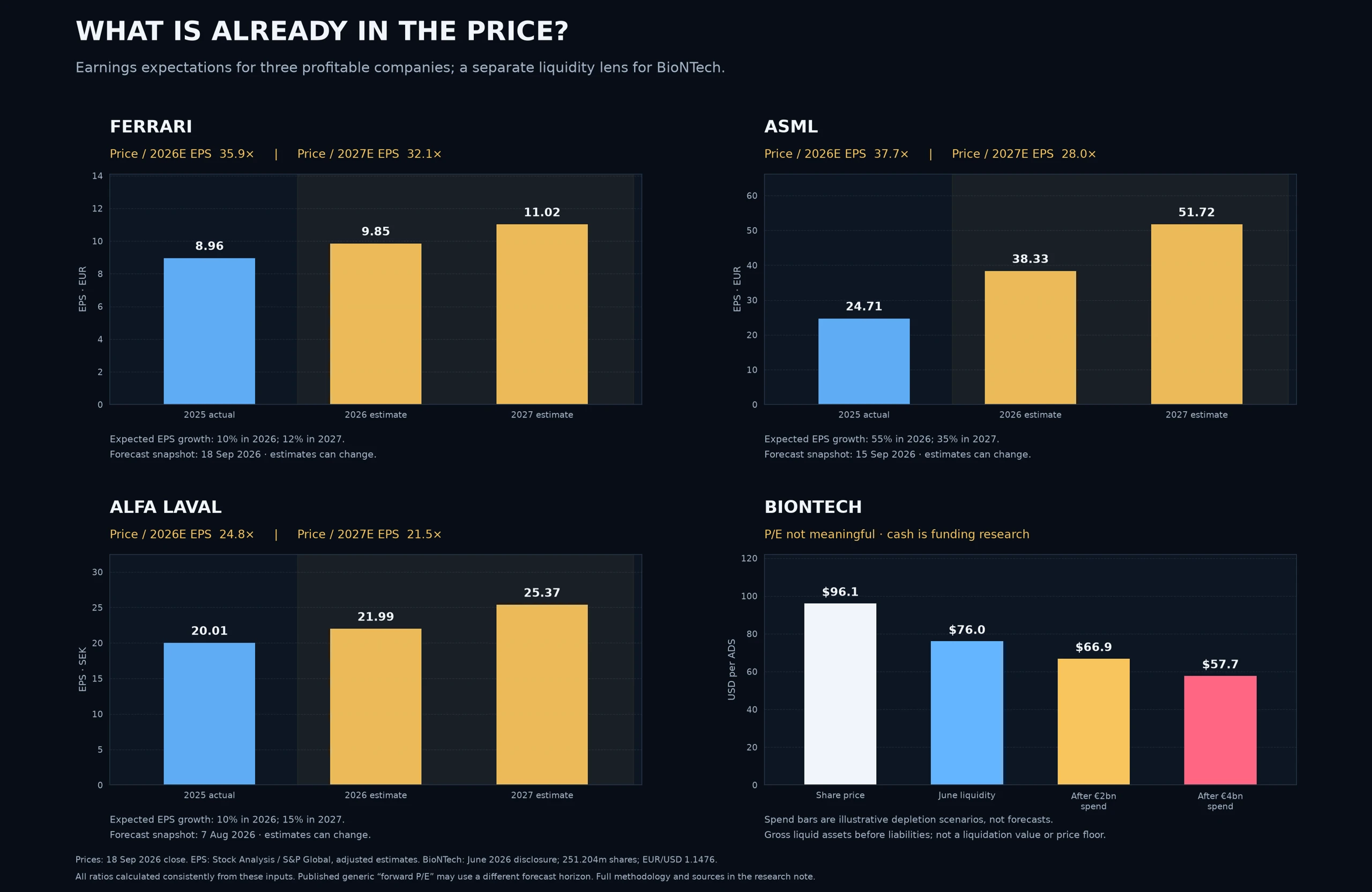
Future earnings are analyst estimates. BioNTech’s spending bars illustrate how research spending could reduce liquid assets; they are not forecasts or minimum share values.
BioNTech requires a different valuation method and more patience. It is loss-making, so an earnings multiple does not tell us much. Its June cash, cash equivalents and security investments amounted to about €16.6 billion. At the exchange rate used in this analysis, that represents approximately $76 per share against a market price of $96.06. The comparison is interesting, but those assets must support the business and its research. They are measured before liabilities and subsequent spending, and the balance-sheet date precedes the share-price date. BioNTech’s financial update.
The clinical evidence also needs to be considered programme by programme. On 28 August, BioNTech terminated a Phase 2 trial of its personalised cancer vaccine in colorectal cancer. September brought encouraging results for a different treatment, gotistobart, but those came from the non-pivotal first stage of a trial. Neither development settles the value of the entire pipeline. Together, they explain why I would wait for stronger confirmatory evidence before treating BioNTech as a growth investment. Its cash gives the company time to work; it does not tell an investor which treatments will succeed. Colorectal trial update, gotistobart results.
I would therefore consider ASML and Alfa Laval for gradual purchases, with a long horizon and a willingness to change my view when the evidence changes. Ferrari stays on the list, but I would prefer a better entry price or earnings upgrades that make the current valuation more comfortable. BioNTech remains a wait. These are judgments about the research, not a report of trades I have made. For each company, I want the next set of results to answer a specific question: can ASML deliver the expected expansion, can Alfa Laval convert orders into profits, can Ferrari grow enough to justify its premium, and can BioNTech turn promising science into convincing clinical outcomes?
Data note: prices are the 18 September 2026 closes, checked against a second price source. P/E ratios use matching currencies and dated adjusted earnings estimates from Stock Analysis/S&P Global: Ferrari 18 September, ASML 15 September and Alfa Laval 7 August. Alfa Laval’s estimate snapshot is older. These are conditional investment views from an initial valuation screen, not a full intrinsic-value assessment or a personalised allocation.
Originally published on Substack on 21 September 2026.